


Read most companies’ sustainability reports and you will find substantive commitments to gender equality in the workplace: pay transparency initiatives, board diversity targets, flexible working policies. What you will find far less of is serious, measurable engagement with gender equality in the supply chain.
For investors applying an ESG or human capital lens, that gap is no longer a peripheral concern. It is an under-priced risk — and, for companies that move early, a source of competitive and regulatory advantage.
Equileap’s 2026 Gender Equality Ranking and Report, which assesses nearly 3,500 publicly listed companies across 24 developed markets, confirms that supply chains remain a significant structural blind spot in corporate gender equality programmes. In some areas, the situation is moving in the wrong direction.
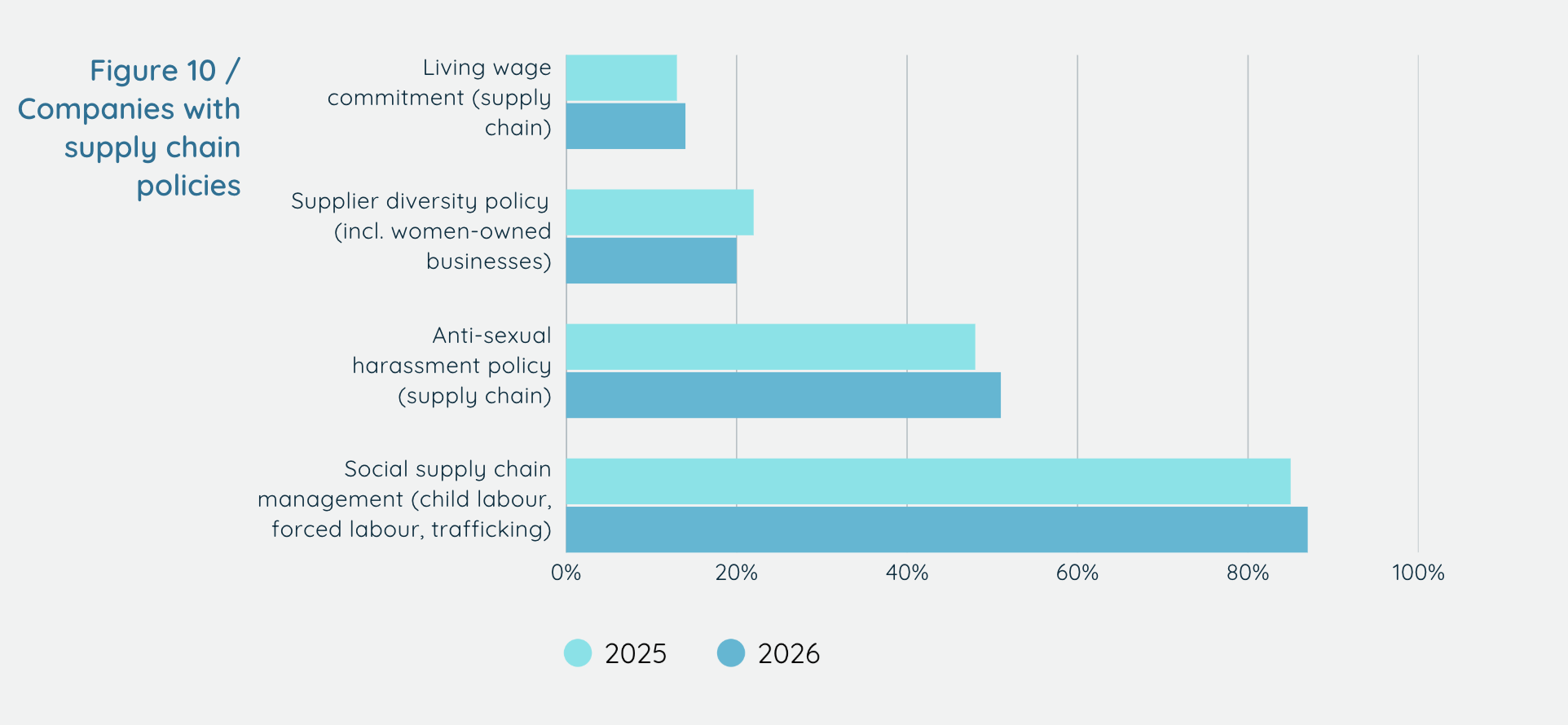
| 87% ↑ from 85% in 2025 | have social supply chain management policies covering child labour, forced labour, and trafficking |
| 51% ↑ from 48% in 2025 | have anti-sexual harassment policies that explicitly cover supply chain partners |
| 20% ↓ from 22% in 2025 | have supplier diversity policies that specifically include women-owned businesses |
| 14% ↑ from 13% in 2025 | have made living wage commitments that extend across their supply chains |
Source: Equileap Gender Equality Scorecard 2026. Assessment of 3,430 public companies across 24 developed markets.
Why Supply Chain Gender Data Is an Investor-Grade Issue
The scale of the exposure is significant. According to the ILO’s October 2025 brief Gender Equality in Supply Chains, women account for roughly 40% of workers in global supply chains overall — a proportion that rises to as high as 80% in labour-intensive sectors such as garments. Despite this concentration, women remain disproportionately clustered in lower-skill, lower-paid roles, particularly in the lower tiers of supply chains where subcontracting through small or informal enterprises is common.
For investors, this translates into a set of concrete risks: reputational exposure from supply chain labour incidents, litigation and regulatory risk as due diligence requirements tighten, and the operational cost of supplier instability in workforces with poor gender outcomes. It also represents a missed opportunity — supplier diversity programmes have been shown to build supply chain resilience through diversification and to create economic pathways for women entrepreneurs.
Yet the ILO concludes that regular gender-disaggregated data collection and analysis across all tiers of supply chains remains the exception rather than the rule. That data deficit makes these risks harder to price — and harder to manage.
The Data Gap: A Structural Problem, Not a Reporting One
At the corporate level, visibility into supply chain gender practices remains limited and inconsistent. The WEPs Tool 2024 Trends Report, drawing on self-assessments from 2,777 companies across 117 countries, found that supply chain and marketplace practices recorded the lowest average score of any category assessed — with particularly low rates of gender-specific supplier assessment and transparency on spending with women-owned businesses.
The Ethical Trading Initiative’s Gender Data Initiative, launched in 2021, has documented a further structural dimension: suppliers frequently lack the internal capacity to provide accurate and reliable gender data even when brands actively request it. This means the data gap is not a simple corporate reporting failure that better disclosure frameworks will resolve. It is embedded in supply chain structures themselves, and closing it requires capability-building at the supplier level alongside improved standards at the corporate level.
Equileap’s supply chain indicators — covering living wage commitments, anti-harassment policies, social supply chain management, and supplier diversity — provide investors and companies with a consistent, comparable baseline for evaluating where commitments currently stand. Combined with structured initiatives such as ETI’s Gender Data Initiative and the ILO’s technical assistance programmes, this data infrastructure offers a starting point for extending gender equality accountability beyond the corporate boundary.
Source: Equileap Global Gender Equality Report and Ranking 2026, Developed Markets edition.
Supplier Diversity: A High-Leverage Intervention in Retreat
Supplier diversity programmes — which actively identify, engage, and support women-owned businesses as suppliers — represent one of the higher-leverage interventions available to large corporations seeking to extend gender equality through their value chains. They create direct economic opportunity for women entrepreneurs, build supply chain resilience through diversification, and extend a company’s gender equality commitments beyond its directly employed workforce.
The Equileap 2026 data shows that only one in five of the companies assessed has such a programme in place — and that proportion declined year-on-year. The retreat is most pronounced in the United States, where supplier diversity commitments fell by seven percentage points in a single year. This reversal is occurring at precisely the moment when the regulatory and stakeholder pressure to demonstrate supply chain due diligence is intensifying, and it represents a material divergence between stated ESG ambitions and observable practice.
For investors conducting ESG due diligence or applying a social lens to portfolio analysis, supplier diversity adoption (or its absence) is a directly measurable indicator of supply chain gender equality commitment — one that Equileap’s Gender Equality Scorecard tracks consistently across markets.
Where Progress Is Being Made
The 2026 data is not uniformly negative. Social supply chain management policies — covering child labour, forced labour, and trafficking — are now in place at 87% of assessed companies, up from 85% the previous year. This reflects both the growing maturity of corporate human rights frameworks and the concrete influence of supply chain due diligence legislation, particularly the German Supply Chain Due Diligence Act and the EU’s forthcoming requirements under the Corporate Sustainability Due Diligence Directive (CSDDD).
Anti-sexual harassment policies covering supply chain partners have also improved materially, reaching 51% of companies. Australia, the UK, Hong Kong, and Singapore each recorded increases of between nine and twelve percentage points in a single year — evidence that significant progress is achievable within short timeframes where companies prioritise it. These examples offer a practical benchmark for engagement by investors seeking to push for improvement in their portfolios.
The Regulatory Direction of Travel: Preparing for CSDDD and Beyond
The regulatory environment is moving firmly in the direction of mandatory supply chain human rights and gender due diligence. The EU’s Corporate Sustainability Due Diligence Directive entered into force in July 2024. While implementation and compliance timelines have been extended to 2027 and 2028 under the Omnibus package, the direction is unambiguous: companies will be required to identify, prevent, and address adverse human rights and environmental impacts across their value chains.
For investors, this trajectory has direct implications for portfolio risk. Companies that have not begun building robust supply chain gender frameworks — including data collection capacity, supplier engagement mechanisms, and clear accountability structures — face growing transition risk as compliance requirements crystallise. Those that have invested early will face lower compliance costs, a stronger audit and reporting position, and greater credibility with regulators and stakeholders.
The current data, as captured in Equileap’s 2026 report, makes clear both the scale of the gap and the direction of movement required. For asset managers, investment analysts, and banks integrating ESG factors into portfolio construction or stewardship activities, supply chain gender performance is an increasingly material dimension that merits dedicated tracking and engagement.
The Takeaway for Investors and Allocators
The gap between a company’s internal gender equality performance and its supply chain practice is currently one of the least systematically analysed dimensions of ESG risk. That is changing — driven by regulation, investor scrutiny, and the growing recognition that the women who make up a significant share of the global workforce are not employed directly by the companies that sit at the top of value chains.