


Disclosure has expanded and board-level numbers have inched upward. Yet at the executive level, progress remains stubbornly slow. At the CEO level, it has stalled entirely. For investors pricing governance risk and corporates benchmarking against peers, the 2026 data makes the gap impossible to ignore.
Ten years ago, the question for most institutional investors was whether gender equality data was material at all. Today, that debate is settled. What Equileap’s tenth annual Gender Equality Report & Ranking — covering nearly 3,500 companies across 24 developed markets — makes clear is that the harder question is now this: why, after a decade of growing scrutiny and rising disclosure, does the pipeline to the top remain so narrow?
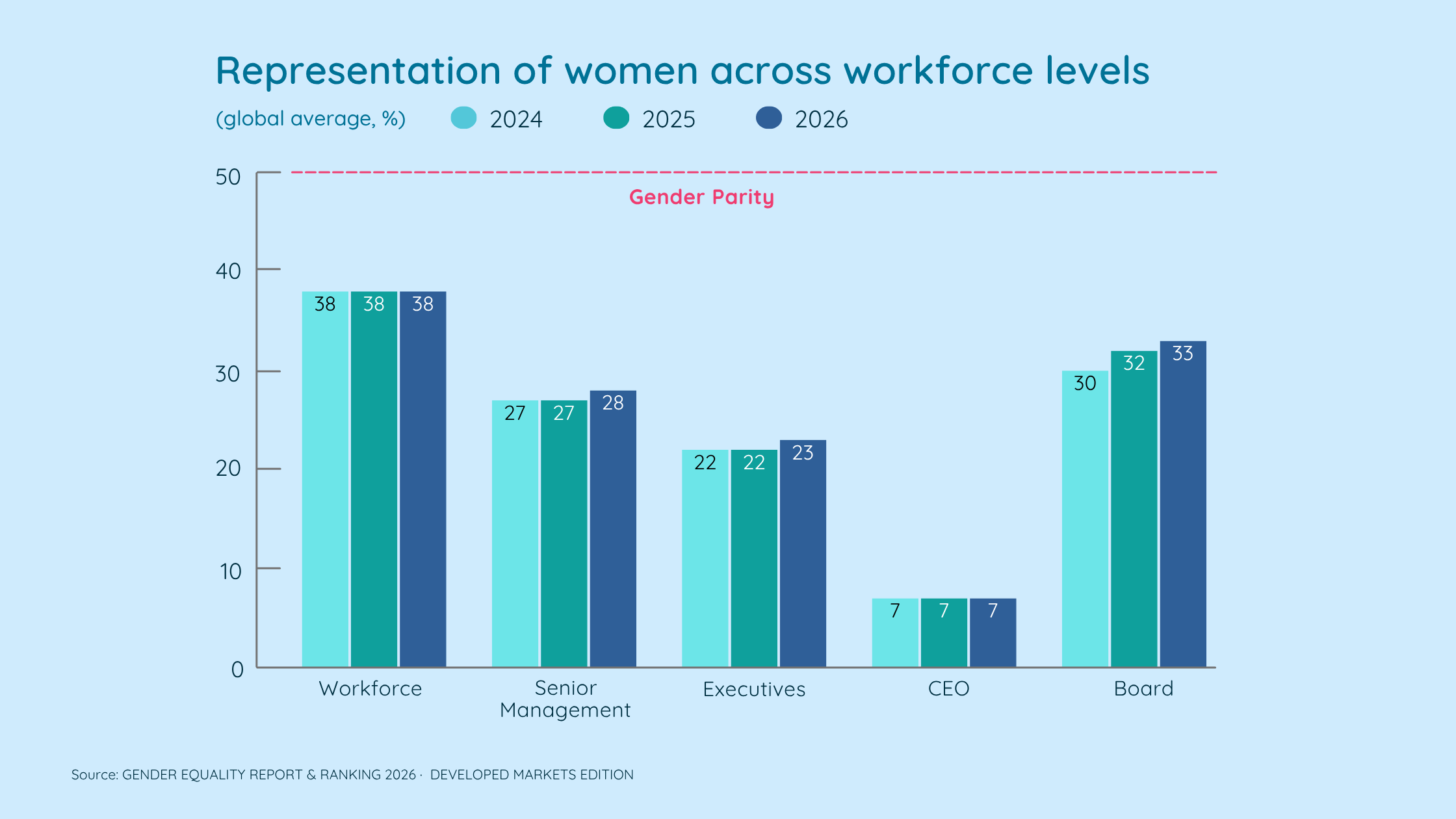
For the last three years, women have made up only 7% of CEOs globally. The 2026 dataset shows marginal gains at board and senior management levels, but it remains evident that there is a persistent, structural gap that voluntary commitment alone has failed to close.
This brief sets out what the data shows, why it matters for investors and companies alike, and what distinguishes the organisations that have made full-spectrum gender balance a reality.
Women at the Top
of CEOs
of Chairs
of CFOs
The data: what Equileap’s 2026 gender equality assessment found
Equileap assesses gender balance at four organisational levels (board of directors, executive team, senior management, and the overall workforce) using our proprietary Gender Equality Scorecard™, which evaluates companies across 21 indicators.
The 2026 global averages are:
Source: Equileap Gender Equality Scorecard™ 2026 — 3,430 public companies across 24 developed markets.
Why gender balance in the workplace matters: the investor and regulatory angle
Gender balance has moved from a values question to a valuation question. A growing body of evidence links diverse leadership to stronger decision-making, reduced organisational risk, and improved long-term financial performance. For ESG analysts and asset managers integrating governance criteria into portfolio construction, the implication is direct: companies with persistent gaps at senior and executive level are not simply underperforming on a social metric. They may be carrying a measurable governance risk.
Regulatory pressure reinforces this, with mandatory disclosure requirements expanding across the European Union, the United Kingdom, and key Asia-Pacific markets. Companies in Equileap’s universe that have not yet developed robust internal reporting on gender balance at multiple organisational levels will find themselves increasingly exposed as frameworks tighten.
For active owners, the 2026 data provides a precise benchmarking tool. The one-percentage-point gains at board and senior management level are real, but they are not sufficient to close the gap within any investment-relevant timeframe at the current rate.
Engagement strategies that focus solely on board composition, rather than the full pipeline from workforce to executive team, are likely to produce the same incremental results the market has seen for the past decade.
Who is leading: women on boards and in executive teams by market
At board level, the correlation between legislative intervention and outcome is clear. France, which introduced mandatory 40% gender quotas for corporate boards in 2011, leads globally with 46% women on boards. Italy, which raised its own board quota from 33% to 40% in 2020, has seen comparable results.
The United Kingdom has achieved similar board-level representation through a transparency-led model, without mandatory quotas, demonstrating that a well-designed disclosure framework, rigorously enforced and publicly reported, can drive meaningful change.
The contrast with the United States is stark. US companies represent 42.5% of all companies in Equileap’s dataset, yet average just under a third of women on boards — 14 percentage points behind France and roughly 27% fewer women in boardrooms the UK.
Executive team representation tells a different story. Australia leads this metric at 32%, followed by Singapore, New Zealand, and Sweden at 31% each. Japan sits at the opposite end, with women representing just 6% of executive teams.
The divergence between countries with strong board numbers and those with strong executive team numbers points to a crucial distinction: board appointments and executive pipeline development are not the same thing, and the data shows which markets have invested in both.
At company level, 51 organisations across Equileap’s 2026 universe achieved gender balance (defined as 40–60% women) across all four organisational levels, up from 38 companies the previous year. These organisations span diverse sectors and geographies and demonstrate that full-spectrum balance is achievable as the result of deliberate, sustained structural effort.
The methodology: how Equileap measures gender equality in the workplace
Equileap’s Gender Equality Scorecard™ is a 21-indicator framework that evaluates companies across four dimensions: gender balance at each organisational level, equal compensation and work-life balance, policies supporting gender equality, and commitment and transparency. Companies are assessed on disclosed, publicly available data, and rankings are produced separately for developed and emerging markets.
The four organisational levels assessed — board, executive team, senior management, and overall workforce — are a deliberate design choice. Measuring only board representation, as many disclosure frameworks and investor screens still do, creates a significant blind spot. A company can achieve strong board numbers through targeted appointment while its executive pipeline remains male-dominated. Equileap’s methodology is designed to surface that gap, not obscure it.
Gender balance is defined as 40–60% representation of either gender at a given level.
What the 2026 gender equality data means for investors, corporates, and policymakers
For investors and ESG analysts, the 2026 data offers both a warning and a differentiation tool. The rising threshold for Equileap’s Top 100, from 63% in 2022 to 71% in 2026, signals that performance is becoming more dispersed. Companies that have embedded gender equality into governance structures are pulling ahead; those relying on incremental, voluntary progress are falling further behind relative to peers. Screening and engagement strategies should account for performance at all four organisational levels, not board composition alone.
For corporates, the evidence from France, Italy, the United Kingdom, and Australia points to a consistent conclusion: structural accountability — whether through legislation, mandatory reporting, or clearly defined internal targets — produces better outcomes than voluntary commitment. The 51 companies that achieved gender balance across all four levels in 2026 treated gender equality as a governance priority, not a communications one.
For policymakers, the cross-country data in the 2026 report provides a natural experiment in policy design. Mandatory quotas accelerate board-level change. Disclosure regimes, when well-designed and consistently enforced, can achieve comparable results without legislative mandates. The executive pipeline gap — visible in almost every market — points to the need for interventions that go beyond the boardroom and address the structural barriers limiting women’s progression into the C-suite.
A decade of data has produced a clear picture: gender balance in corporate leadership is improving but not nearly fast enough. The question for investors and companies is no longer whether gender balance matters; it’s whether the pace of change is fast enough to keep up with rising regulatory expectations, investor scrutiny, and competitive pressure from the companies that have already done the work.